omniVUE Intelligence
From operational data to governed decisions.
The intelligence layer inside omniVUE connects live context, evidence, AI-assisted analysis and accountable workflows—helping people understand what is happening and coordinate what comes next.
Operations leaders · Command teams · System owners · Decision-makers

01
Shared operational context
Connect the live status, location, history and constraints behind an event.
02
Explainable recommendations
Show operators the reasoning and evidence behind a proposed response.
03
Governed workflows
Bring playbooks, policy checks and approval gates into the operating environment.
04
People remain in control
External actions stay visible, accountable and subject to operator approval.
The decision layer
Intelligence is useful when it changes the workflow.
omniVUE Intelligence is not a separate chatbot or an autonomous control system. It is a set of decision-support and orchestration capabilities embedded in the operational environment.
01
Bring the context together
Unify relevant system data, live assets, operational conditions and geospatial context around the decision at hand.
02
Structure the situation
Turn important events into incidents with evidence, priorities, roles, timelines and a shared operational record.
03
Assist the operator
Use tool-grounded AI assistance to summarize conditions, answer operational questions and propose next steps.
04
Govern the response
Apply configurable playbooks, policy checks and approval gates before actions move beyond the platform.
05
Preserve the evidence
Keep recommendations, selections, approvals and supporting context together for review and accountability.
06
Rehearse and improve
Run realistic scenarios through the same environment for demonstrations, testing, training and after-action review.
Health Operations demonstration
A Code Red becomes a coordinated capacity response.
HealthOps demonstrates how omniVUE Intelligence can sit above existing operational systems to support facility-capacity and patient-transfer coordination across a health network.
01
Detect capacity pressure
A facility enters Code Red and the operating picture identifies the need to divert or transfer demand.
02
Rank viable options
Candidate facilities are compared using available capacity, travel time and current operating context.
03
Coordinate transport
Ambulance availability, assignments, routes and local conditions are visible in the same decision context.
04
Approve the response
The governed playbook records the recommendation and requires an authorized operator before execution.
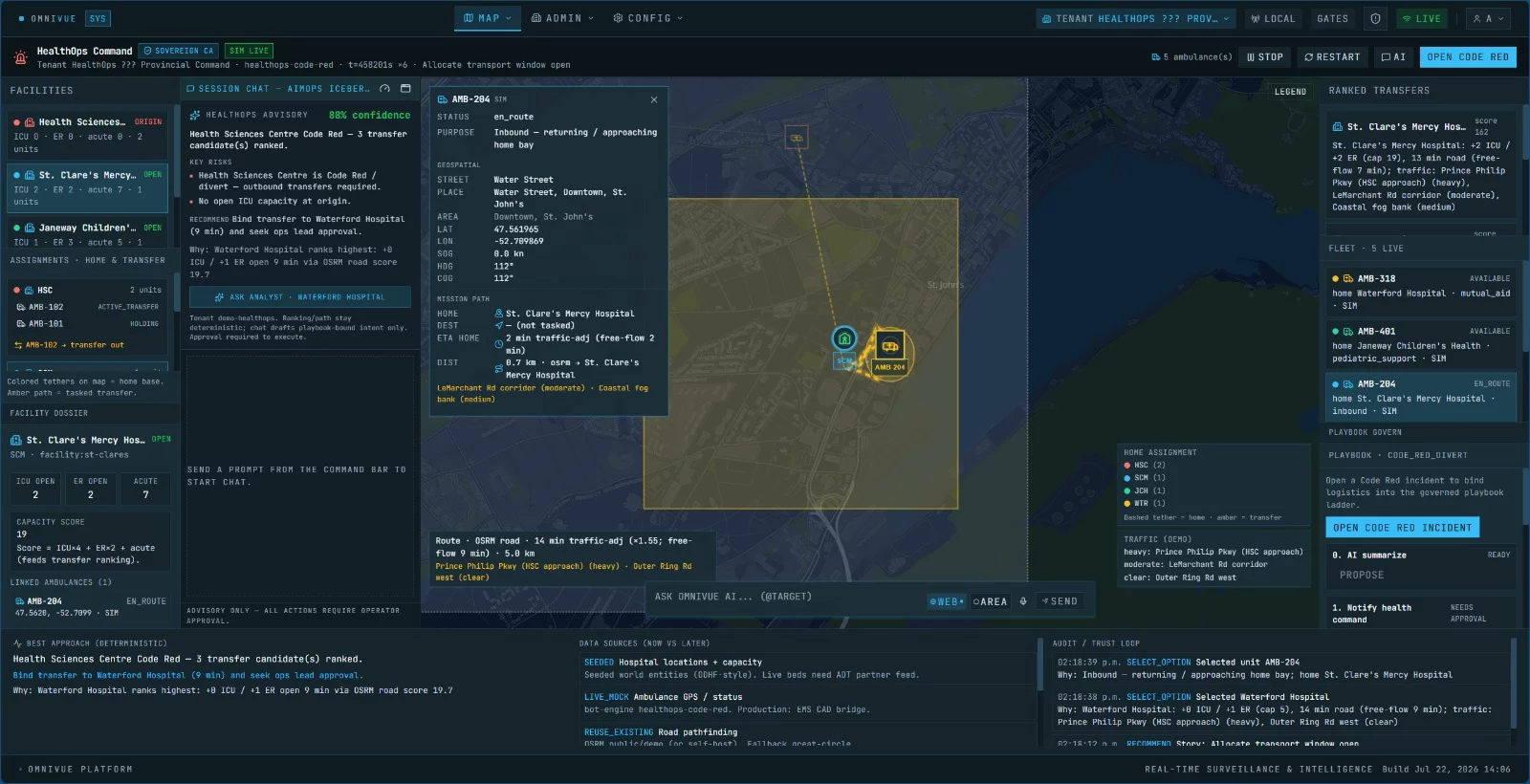
What the demonstrator brings together
Evidence at the point of decision.
Instead of asking a coordinator to reconcile several disconnected views, the demonstration assembles the operating context around a single response pathway.
HealthOps is operational decision support. It is not a diagnostic system, does not replace clinical judgment and does not execute external actions without operator approval.
One intelligence pattern · Many missions
Different operating environments. The same coordination problem.
01 \ HEALTH SYSTEMS
Capacity and transfer coordination
Help command teams understand system pressure, compare response options and coordinate an accountable operational response.
02 \ MARITIME OPERATIONS
Incident and security response
Connect vessel behaviour, zones, cameras, conditions, evidence and response playbooks around an emerging incident.
03 \ REMOTE OPERATIONS
Asset and mission coordination
Bring distributed assets, changing conditions and operating constraints into a shared decision environment.
A focused path to value
Start with the decision—not a platform replacement.
The strongest first engagement is a tightly defined operational workflow that matters to the buyer and can be demonstrated with their roles, controls and information sources.
01
Choose one consequential decision
Start with a recurring operational problem where fragmented information slows understanding or coordination.
02
Map the evidence and controls
Identify the systems, roles, rules, approvals and actions required to support that decision responsibly.
03
Build a focused demonstration
Configure omniVUE around the workflow so decision-makers can see the capability in their own operating context.

Canadian-built software for complex operational environments.
PO Box 1506, Station C
St. John's, NL
A1C 5N8
Canada
© 2026 ENGAGE CREATIVE TECHNOLOGIES